

Introduction
One of the most common DSG gearbox faults/symptoms we see is when the vehicle becomes restricted to using only one set of gears. This typically presents as either odd gears only (1, 3, 5, 7) or even gears only (2, 4, 6), and in some cases the vehicle may lose drive completely.
This issue is widely reported across VW, Audi, SEAT and Škoda vehicles fitted with DSG transmissions, including the DQ200, DQ250, DQ381 and DQ500 gearboxes.
While this can feel like a sudden and serious failure, it is important to understand that in many cases the gearbox is intentionally limiting itself as part of a protective strategy.
Quick Symptoms
- Vehicle only selects odd gears (1, 3, 5, 7) or even gears (2, 4, 6)
- Loss of drive when selecting certain gears
- Gear indicator flashing on the dashboard
- Transmission warning light illuminated
- Vehicle goes into limp mode
- Harsh or sudden gear engagement
- “Gearbox malfunction” message displayed
Q: Can I still drive the car?
A: In some cases yes, but only in a limited capacity. The gearbox may allow you to limp the vehicle, but continued driving is not recommended.
Q: Does this fault get worse over time?
A: Yes. What often starts as an intermittent issue will typically progress into a permanent loss of drive if left unresolved.
If you’re experiencing any of the above, the issue is already developing and should be diagnosed as soon as possible.
What Drivers Commonly Report
Across forums and our customer enquiries, the same patterns appear repeatedly.
Drivers often report that the car suddenly loses half of its gears, either on startup or during normal driving. Some find that cycling the ignition temporarily restores normal operation, only for the fault to return shortly after.
Others describe the gearbox dropping into limp mode without warning, accompanied by a flashing gear indicator and restricted gear selection.
In more severe cases, the vehicle will not move at all despite selecting drive or reverse.
Common Fault Codes
When scanned, these faults are usually accompanied by gearbox-related fault codes such as:
P17BF – Hydraulic pump protection active
P1895 – Pressure loss in system
P0841 – Hydraulic pressure sensor implausible signal
P173D – Gear selection failure
P072C / P072D – Gear not selectable
P176F / P175E – Clutch or shift control issues
These codes typically point toward faults in hydraulic pressure, clutch control, or internal mechatronic components.

Technical Explanation
DSG gearboxes operate using two independent clutch systems:
Clutch K1 controls odd gears (1st, 3rd, 5th, and 7th on 7-speed models)
Clutch K2 controls even gears (2nd, 4th, 6th)
When the gearbox detects a fault affecting one side of the system, it will often enter a failsafe mode. This is designed to reduce the risk of further damage to the transmission.
Instead of continuing to operate both clutches and potentially causing internal damage, the gearbox isolates the affected system and continues to operate using the remaining functional clutch. This is why the vehicle becomes restricted to either odd or even gears.
In these situations, the gearbox may still allow limited movement so the driver can safely move or limp the vehicle. This is a controlled response by the transmission control unit.
However, not all faults allow this.
If the issue affects critical systems such as overall hydraulic pressure, control module operation, or multiple components at once, the gearbox may disable drive completely to prevent severe internal damage.
While the symptom is the same across DSG gearboxes, the reason behind it varies depending on the transmission type.
Here are some examples of issues that cause this symptom depending on the transmission version.
DQ200 (0AM / 0CW) – Hydraulic Pressure Loss
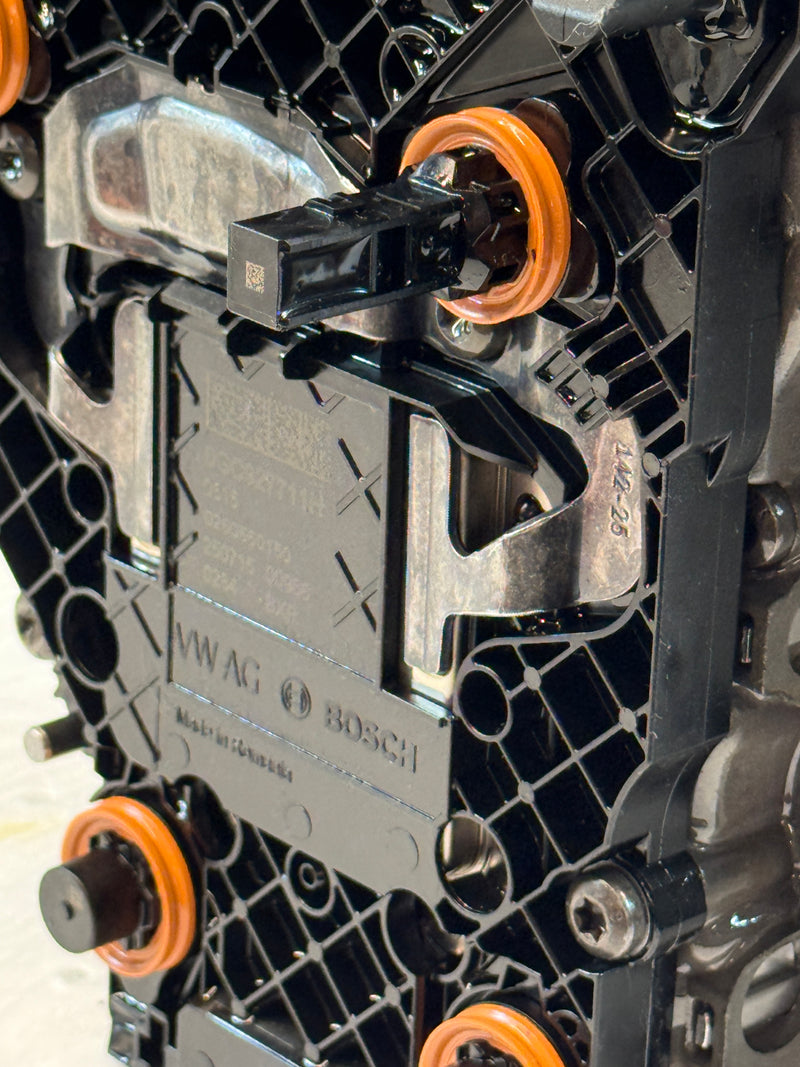
On DQ200 gearboxes, this fault is most commonly linked to hydraulic pressure loss within the mechatronic unit.
A typical failure we see involves the pressure accumulator area within the valve body. Over time, this can lead to internal cracking or leakage, meaning the system cannot hold pressure correctly.
When this happens:
- The gearbox cannot maintain pressure for both clutches
- It may isolate one clutch system, resulting in odd or even gears only
- In more severe cases, it will disable drive completely
This is often accompanied by fault codes such as P17BF, P1895 and P0841.
If left unresolved, the hydraulic pump can run continuously and eventually fail, which removes drive entirely.
DQ381 (0GC) – Clutch Pressure Regulation Faults
On newer DSG units such as the DQ381, the issue is typically related to clutch pressure regulation rather than physical pressure loss.
In these cases, the gearbox may detect that one clutch is not operating within expected parameters due to incorrect pressure readings or solenoid control issues.
When this occurs:
- The gearbox disables the affected clutch
- The vehicle continues to operate using the remaining clutch
- The result is restricted to either odd or even gears
These faults are often intermittent at first and may present as harsh shifting or delayed gear engagement before progressing into limp mode.
DL501 (0B5) – Solenoid and Control Faults
On longitudinal DSG units such as the DL501, similar symptoms can occur due to faults within the mechatronic control system.
This can include issues with pressure control solenoids, valve operation, or the internal circuit board.
Because this gearbox operates two internal gear sets, a fault affecting one side can result in:
- Loss of either odd or even gears
- Gear selection faults
- Sudden limp mode activation
In many cases, the gearbox will attempt to maintain drive using the unaffected system. However, if the fault escalates or affects multiple components, it will disable drive completely.

Key Takeaway
Although being stuck in odd or even gears can feel like a major failure, it is often the gearbox protecting itself.
The important point is that while the symptom is consistent, the underlying cause is not.
Correct diagnosis is essential to determine whether the issue is related to hydraulic pressure, clutch control, or electronic components — and to ensure the correct repair is carried out first time.
Can You Drive With This Fault
If the gearbox has entered a fail-safe mode and still allows movement, the vehicle can usually be driven short distances.
However, this should only be done to move the vehicle to a safe location or workshop. Continuing to drive can lead to:
- Complete loss of drive
- Clutch damage
- Further internal gearbox damage
- Increased repair costs
If the gearbox has disabled drive completely, recovery will be required.
Repair Options
The correct repair depends on the root cause identified during diagnosis.
Common repair routes include:
Repair or replacement of the mechatronic unit
Replacement of the hydraulic pump or accumulator
Solenoid or sensor replacement
Clutch pack inspection or replacement if damage has occurred
At Eco Torque, we specialise in DSG diagnostics, repair and replacement, ensuring the correct fault is identified before any parts are replaced.
Final Thoughts
A DSG gearbox stuck in odd or even gears is often the result of the transmission protecting itself. While this failsafe mode can allow limited driving in some cases, it should not be relied upon.
Early diagnosis is key. Addressing the issue before it progresses can prevent further damage and significantly reduce repair costs.
Parts for this repair
We stock the parts for this job and ship them from our Arlesey workshop. Not sure which gearbox you have? Send us your registration and we will confirm it before you order.
- DQ200 (0AM / 0CW) parts — 83 lines
- DQ250 (02E / 0D9) parts — 52 lines
- DQ381 (0GC) parts — 34 lines
- DQ500 (0BH / 0BT) parts — 36 lines
- DL501 (0B5) S-Tronic parts — 46 lines
- All DSG parts — 201 lines across the DSG range
Eco Torque Contact Details
If your DSG gearbox is showing any of these symptoms, contact our team for expert advice and repair options.
Eco Torque Ltd
Unit 1A Portland Industrial Estate
Hitchin Road
Arlesey
SG15 6SG
Telephone: 01462 835335
Email info@eco-torque.co.uk
Please join the discussion in our forum here.